Best Low-Cost CRM Solutions for Small Business in Malaysia
Malaysian small business owners face a sharp dilemma today. They need low-cost CRM solutions to compete, but legacy enterprise platforms price them out. Leads leak through spreadsheets, WhatsApp conversations get chaotic, customer data scatters across phones and notebooks, and revenue slips through the cracks.
The good news? Affordable, mobile-first CRM tools tailored for Southeast Asia are now available. Unlike expensive enterprise platforms such as Salesforce or Oracle, these solutions are built for Android users and integrate naturally with Malaysian workflows. This article maps the landscape with market data and ROI insights so you can choose quickly and confidently.
Why Malaysian SMEs Need Low-Cost CRM Solutions Now

According to the Southeast Asia CRM Market Report, 77% of Malaysian SMEs remain at the entry stage of digitalization—creating massive room for CRM modernization. The gap between digital leaders and laggards continues to widen, while Malaysia’s CRM market expands rapidly, driven by e-commerce growth and rising customer expectations.
Without CRM, small businesses lose visibility. A prospect calls on Monday, but the owner forgets to follow up by Friday. Sales reps duplicate effort, quotes vanish inside email threads, and customer history lives in someone’s memory instead of a system. When that person quits, knowledge walks out the door.
The regional impact is measurable. Indonesian SMEs report sales uplifts of up to 30% within one year of CRM adoption, while Thailand’s Go Digital ASEAN initiative found that 69% of trained micro and small firms achieved revenue growth after adopting customer-facing digital tools.
Academic research reinforces the pattern. A study by Universiti Teknologi Malaysia involving 240 SMEs confirms that CRM adoption positively correlates with stronger marketing performance and improved financial results.
Also read: Best CRM Software in Malaysia for SMEs (2026 Guide)
The Real Cost of “Free” Spreadsheets

Excel feels free because it costs nothing upfront, but hidden costs pile up fast. Manual data entry burns hours weekly. Version control breaks when three people edit the same file. Sales forecasts rely on guesswork, not pipeline data. Customer follow-ups depend on memory, not automated reminders.
Customer data management in spreadsheets also creates compliance risks. Malaysia’s Personal Data Protection Act 2010 demands secure handling of personal information. Spreadsheets offer zero access control. Anyone with the file sees everything. Audit trails don’t exist. Data breaches become inevitable.
CRM fixes these problems systematically. Cloud-based platforms provide single sources of truth. Role-based permissions protect sensitive data. Automatic activity logs satisfy audits. Mobile access lets field teams update deals in real time. For businesses outgrowing spreadsheets, low-cost CRM solutions deliver structure without breaking budgets.
Also read: Field Sales Software for Malaysian SMEs: Stop Guessing, Start Tracking
What Low-Cost CRM Solutions Actually Mean in 2026

Pricing transparency matters. Malaysian SME owners need clear numbers, not vague “contact us” buttons. Here’s the 2026 landscape for CRM pricing in Malaysia:
- Free tiers: HubSpot CRM, Zoho CRM, and Freshsales offer genuinely usable free plans with unlimited users, basic pipelines, and contact management. Perfect for startups testing CRM concepts.
- Entry paid plans: RM50-90 per user per month unlocks automation, reporting, and integrations. Zoho Standard starts around RM60/user/month. Local platforms like TargetCRM and CentrePoint CRM target RM50-200/month for small teams.
- Mid-tier options: RM100-180/user/month gets enterprise-grade features at SME prices. HubSpot Sales Hub Starter runs RM180/user/month. Salesforce Essentials sits around RM100/user/month.
Regional providers of cloud-based low-cost CRM solutions for SMEs often beat global giants on total cost. They skip expensive partner networks, localize without customization fees, and price for Malaysian buying power—not Silicon Valley budgets.
Also read: How to Track Field Sales in Malaysia Without Violating PDPA
Key Features of Low-Cost CRM Solutions Needed by Malaysian SMEs
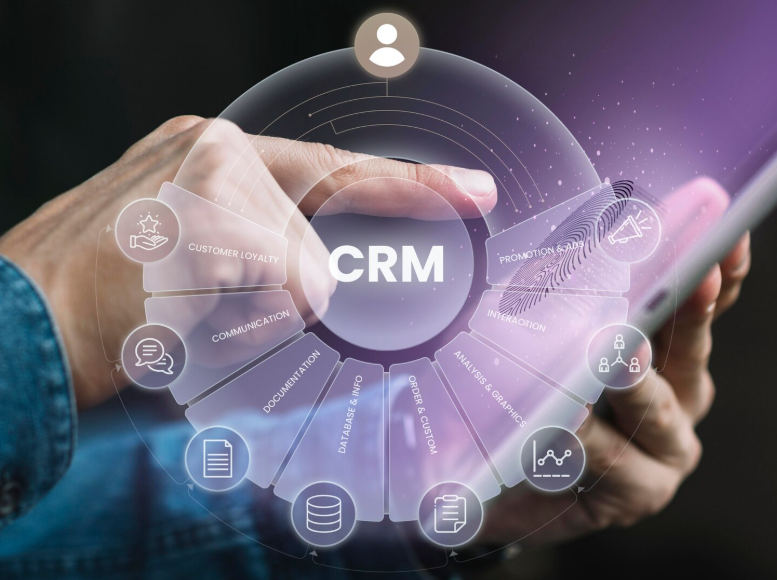
Malaysian SME owners don’t need 500 features. They need five that work flawlessly. The best low-cost CRM solutions focus on practical tools that directly improve sales visibility and customer management. Research and user feedback consistently highlight these priorities:
Contact and company management—Store customer details, interaction history, and notes in one place. Effective low-cost CRM solutions allow teams to tag contacts by segment, source, or priority and search instantly instead of scrolling through notebooks.
Sales pipeline visibility—Visualize deals by stage: lead, quote sent, negotiation, closed. A simple drag-and-drop interface beats complex workflows. The right low-cost CRM solution shows what needs attention today, not buried inside complicated dashboards.
Mobile access—Field sales teams work from cars and Kopitiams, not desks. Mobile CRM solutions with offline sync let reps log visits, update deals, and check notes without WiFi—an essential feature in modern low-cost CRM solutions built for Southeast Asia.
WhatsApp and email integration—Malaysian customers live on WhatsApp. Low-cost CRM solutions that capture WhatsApp conversations alongside email threads create complete customer timelines. No more “what did we discuss last month?”
Reporting and analytics—How many leads came in? Which source converts best? What’s the average deal size? Even low-cost CRM solutions must answer these questions clearly—without requiring Excel exports.
Bonus: ROI rises sharply when these systems automate follow-up reminders, duplicate detection, and task assignment. Small teams multiply output without hiring.
Also read: Stop Client-Site Fraud with Geofencing Client Solutions in Malaysia
Regional vs. Global CRM: The Malaysia Angle
Global platforms like Salesforce, HubSpot, and Zoho dominate headlines. They offer mature features, vast app ecosystems, and proven reliability. But they’re not always optimal for Malaysian SMEs.
Regional advantages include local currency pricing, Malaysian ringgit billing, and SEA-specific workflows. Platforms built for Southeast Asia understand that businesses here rely heavily on WhatsApp, not just email. They integrate with local accounting systems like SQL and AutoCount. They offer Bahasa support and regional customer service hours.
Local providers like TargetCRM emphasize PDPA compliance, HRD Corp certification (making training and implementation claimable for eligible SMEs), and Malaysian Digital (MD) Status recognition. For businesses seeking government grants or digital adoption subsidies, local platforms simplify approval processes.
Global platforms counter with deeper feature sets, AI-powered insights, and massive integration marketplaces. HubSpot free tier remains strong for startups wanting all-in-one marketing plus CRM.
The smart move? Start with a budget-friendly CRM tool that matches your current workflow. Scale up when revenue justifies premium features.
Also read: Best Remote Sales Monitoring and CRM Tools in Singapore
How SMEs in Malaysia Actually Choose CRM

Real-world adoption patterns reveal practical decision-making. Most Malaysian SME owners follow a similar path:
Phase 1: Pain recognition. Lost sales, frustrated customers, or team chaos force action. The “we’ll just remember” approach fails visibly.
Phase 2: Free trial blitz. Owners test 2-3 platforms simultaneously. They input real customer data, run mock pipelines, and check mobile apps during actual sales calls.
Phase 3: Ease vs. power trade-off. Simple interfaces win early. Businesses pick tools their teams will actually use over feature-packed systems requiring training budgets they don’t have.
Phase 4: Integration check. Does it connect to existing accounting software? Can it import from spreadsheets cleanly? Will it export for payroll or reports?
Phase 5: Cost reality. Per-user pricing adds up fast. A 10-person team at RM100/user/month means RM12,000/year. Owners calculate whether increased sales will cover costs within 6-12 months.
Success rates are highest when businesses prioritize user training and choose user-friendly low-cost CRM solutions designed for smaller teams rather than enterprise-level platforms.
Also read: Top Sales Management Software for Indonesian Businesses
The Future of Low-Cost CRM Solutions for Malaysian SMEs
Market trends point toward deeper AI integration and tighter ecosystem connections. The question for Malaysian small businesses isn’t whether to adopt CRM, but how quickly.
Government support accelerates this shift. Singapore’s SMEs Go Digital program subsidizes up to 50% of pre-approved CRM solutions. In Malaysia, a collaboration between Zoho and Cradle Fund delivers USD 10 million in software credits to 4,400 start-ups. Similar grant schemes and digital transformation incentives continue expanding across Southeast Asia, lowering adoption barriers.
For Malaysian SME owners, the strategic imperative is clear: adopt low-cost CRM solutions now, before competitors capture the digital advantage.
Also read: Tapping into Indonesia’s Special Economic Zones Advantage
Why Mobile-First Low-Cost CRM Solutions Matter for Malaysian Sales Teams

Malaysia’s workforce is highly mobile—sales reps visit clients, service teams travel to sites, and distributors operate from vans. Desktop-only CRM dies on arrival.
Mobile CRM solutions deliver specific advantages for Malaysian contexts:
- GPS-tagged visits: Log client meetings with location proof, useful for territory management and incentive verification.
- Offline data entry: Reps capture deal updates in remote areas with poor connectivity, then sync when signal returns.
- Photo and signature capture: Attach product photos, delivery proof, or client sign-offs directly to CRM records from phone cameras.
- Push notifications: Alert teams about hot leads, overdue follow-ups, or new assignments instantly, not after they return to office.
For businesses where “office” means wherever the owner happens to be standing, mobile-first small business CRM software aligns perfectly with operational reality.
Also read: A Foreign Business Guide to Indonesia’s Product Certification
CRM Integration: The Hidden Deal-Breaker

Many Malaysian SMEs already use accounting software (SQL, AutoCount, Xero), messaging (WhatsApp Business), and e-commerce platforms (Shopee, Lazada). CRM must integrate seamlessly; otherwise, it creates costly data silos.
Essential integrations include:
- Accounting and invoicing: Automatically push won deals into invoicing systems. Sync customer details bidirectionally so changes update everywhere.
- Email and calendar: Track email opens, schedule meetings from CRM, and log interactions without manual copying.
- WhatsApp: Capture WhatsApp conversations as CRM activities. Send bulk messages to customer segments directly from the CRM interface.
- E-commerce: Import online orders as CRM opportunities. Track customer lifetime value across offline and online channels.
- Payment gateways: Record payment status, send automated receipts, and flag overdue invoices inside CRM dashboards.
Regional platforms often pre-integrate with Malaysian tools. Global giants require Zapier or custom API work, adding complexity and cost. For SME digital transformation in Malaysia, seamless integration prevents adoption failure.
Also read: 9 Current Trends in Indonesia’s Food & Beverage Industry
Common CRM Mistakes Malaysian SMEs Make

Learning from others’ failures speeds your success. Common pitfalls include:
- Buying features, not solutions—Advanced AI sounds impressive but means nothing if your team needs basic pipeline visibility first.
- Ignoring mobile requirements—If your sales team works in the field, desktop-only CRM guarantees low adoption and wasted investment.
- Skipping integration checks—Discovering your CRM won’t talk to your accounting software after purchase wastes months and money.
- Under-investing in training. Even simple CRM fails without team buy-in. Budget time for onboarding, not just software licenses.
- Choosing based on brand alone—Salesforce dominates globally but might be overkill and overpriced for a 5-person Malaysian distributor.
- Forgetting data migration—Moving years of spreadsheet data into CRM takes planning. Rushed migrations corrupt records and kill trust.
Smart buyers pilot with real data, involve actual users in evaluation, and choose affordable CRM Malaysia platforms that match current team skills and workflows.
Among the regional platforms competing in this space are solutions built specifically for Southeast Asian operational realities—including Malaysian SMEs.
Also read: Top 70 FMCG Companies in Indonesia 2025
Hadirr: Affordable CRM Solution for Malaysian SMEs

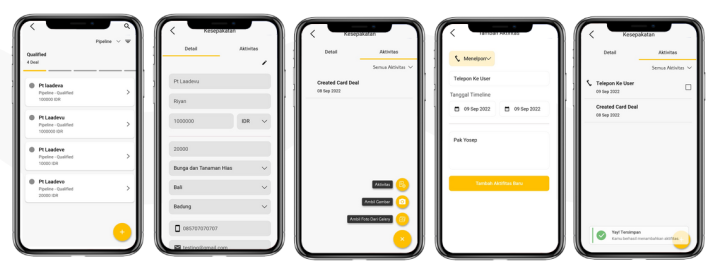
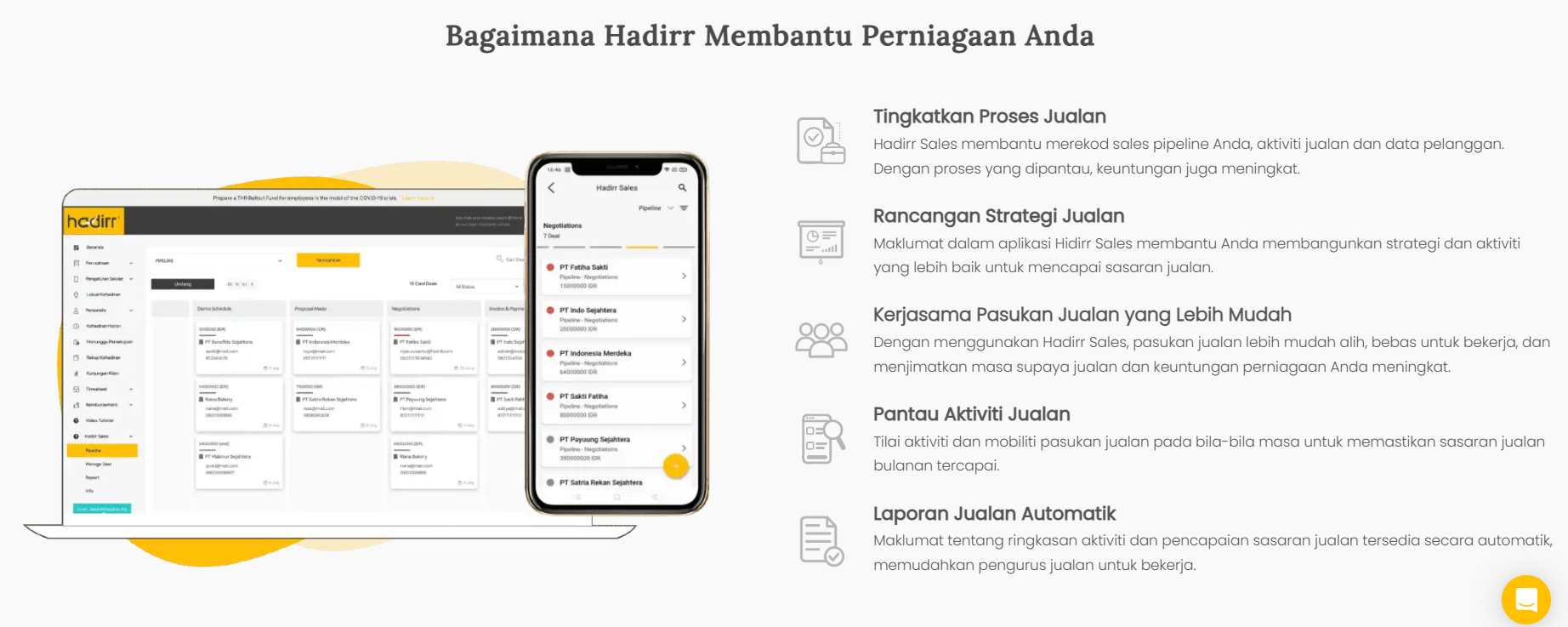
While global platforms dominate market share, Hadirr addresses specific Malaysian SME pain points that enterprise CRM often ignores. Hadirr Sales is a mobile CRM solution designed to support field sales teams’ performance and mobility, ensuring that every stage of the sales pipeline, customer interaction, and activity is documented and easily monitored.
For Malaysian SME owners, Hadirr Sales delivers:
- Improved sales processes: Pipeline stages, sales activities, and customer data are organized and tracked in real time.
- Better strategy and insights: Monitor sales activity anytime and develop strategies to consistently meet monthly targets.
- Team collaboration: Mobile-first design lets teams work anywhere, coordinate efficiently, and save time.
- Automatic reporting: Sales reports and activity summaries are generated instantly, reducing manual work.
- Affordability: After subscribing to the main Hadirr platform, two admins and two employees get Hadirr Sales free. Scale the number of users as needed, paying only for what your team uses.
Boost Your Sales with Hadirr Sales Today
Stop losing deals to scattered spreadsheets and missed follow-ups. Your sales team deserves tools that match how they actually work—mobile, fast, and Malaysian-ready.
Hadirr Sales is the mobile CRM solution built for SMEs in Southeast Asia. With Hadirr, you can:
- Track every opportunity in real time, from lead to closed deal.
- Automate follow-ups so no customer ever slips through the cracks.
- Access data anywhere—offline or online—for field teams on the go.
- Get clear performance insights to hit your monthly sales targets.
- Scale flexibly with one of Southeast Asia’s leading low-cost CRM solutions.
Don’t let disorganization slow your growth. Don’t overpay for enterprise CRMs you don’t need. Deploy Hadirr Sales today and gain full visibility over your pipeline.
Start your free trial and turn every lead into measurable growth.