

Stop Client-Site Fraud with Geofencing Client Solutions in Malaysia
Client visits are where trust is built—and where fraud can quietly occur. For Malaysian businesses, implementing geofencing client controls has become a practical way to prevent false visit claims and location manipulation—such as employees saying, “I’m at the site, boss,” when they were never there.
Location-aware apps now allow attendance and visit logs to be locked to verified GPS coordinates. Off-site clock-ins, fake visits, and time theft become significantly harder to justify.
Below is a structured look at how client-site fraud happens, why it persists, and how geofencing tools—including Hadirr—help Malaysian organisations regain control.
Client Site Fraud: The Hidden Cost for Malaysian Businesses

Malaysian employers face growing pressure to ensure attendance and visit data are accurate. Time and location records directly affect payroll, overtime, travel allowances, reimbursements, and even client service-level agreements (SLAs).
When employees operate at client sites—whether in sales, maintenance, distribution, inspections, or service delivery—the risk of employee location fraud increases. Supervisors are not physically present, and traditional monitoring methods often rely on trust.
Common patterns include:
- Sales reps claiming to be at a client site while still at home or at a nearby café
- Field staff clocking in “on site” but remaining in their vehicle without performing work
- “Ghost visits” where forms are submitted, yet the customer never saw a representative
- Remote attendance recorded at one site but actual work carried out elsewhere
HR and operations teams across Malaysia report that manual timesheets, basic selfie apps, or loosely configured GPS capture frequently lead to disputes, payroll corrections, and mistrust.
The financial impact extends beyond minor time theft. It can include:
- Incorrect client billing
- Missed service commitments
- Inflated travel claims
- Erosion of trust with key accounts
Over time, these small inconsistencies accumulate into significant operational and reputational risk.
Also read: Top Sales Management Software for Indonesian Businesses
Why Geofencing Works Against Client-Site Fraud

Geofencing is a location-based technology that creates a virtual boundary around a physical area using GPS, Wi-Fi, or mobile network signals. When a device enters or exits that boundary, the system can trigger specific actions—such as allowing a clock-in, validating a visit, or flagging suspicious activity.
In HR and field operations, this capability directly addresses location fraud.
- Malaysian HR technology providers consistently highlight that a properly configured geofencing attendance system prevents employees from clocking in from home or nearby public spaces instead of the designated office or customer location.
- Academic research into fraud-resistant attendance systems further supports this model. Enforcing attendance registration strictly within a predefined geofence significantly reduces classic “proxy attendance” scenarios—such as one employee checking in on behalf of another.
- More advanced implementations layer geofencing with facial recognition, device verification (e.g., IMEI matching), or timestamp validation to reduce spoofing and duplicate entries.
In practical terms, connecting attendance and visit logs to a clearly defined GPS-based time tracking perimeter makes it far more difficult to misrepresent physical presence at a client site. Employees may still vary in performance—but the basic claim of “I was there” becomes objectively verifiable.
Also read: Tapping into Indonesia’s Special Economic Zones Advantage
How Client-Site Fraud Happens in the Real World

Understanding real-world tactics helps Malaysian businesses design better controls and prevent losses:
- Off-site clock-ins
Even selfie attendance apps can be gamed without geofencing, allowing employees to clock in from anywhere using a stored background photo. - Fake GPS and location spoofing
Some employees use mock GPS apps to trick basic location checks, especially when the system doesn’t validate coordinates or detect suspicious jumps in movement. - Vehicle-based “visits”
Field staff may reach the general area but remain in their vehicle rather than entering the client premises. - Proxy or buddy punching
Without biometric or device-bound verification, colleagues can clock in on each other’s behalf or share QR codes. - Back-dated or bulk updates
Spreadsheet-driven client site visit tracking allows activities to be “reconstructed” later, often without GPS or timestamp proof.
Modern geofencing client solutions close these loopholes by combining GPS boundaries, timestamp enforcement, and, in some cases, facial recognition or in-app camera controls.
Also read: Why Foreign Companies in Indonesia Struggle to Hire Top Locals
Malaysia’s Shift to Geofencing and GPS Attendance

Across Malaysia, GPS-based attendance and visit tracking is rapidly gaining traction, particularly in construction, logistics, and field sales. This shift reflects broader changes in work culture: a Microsoft survey found that 77% of Malaysian workers prefer flexible or hybrid work arrangements, increasing pressure on employers to ensure accurate attendance and visit verification.
Recent findings from Cisco’s Hybrid Work Study in Malaysia further reinforce this shift. Under hybrid arrangements, 59.7% of employees reported better quality of work, 55.1% saw productivity gains, 61.3% improved job knowledge and skills, and 49.5% experienced better workplace relationships and attitudes.
While these figures highlight the performance upside of hybrid models, they also introduce a critical operational challenge—maintaining accountability and real-time visibility across distributed and mobile teams.
Key examples:
- Mobile attendance apps with geofencing and photo verification control exactly where staff can clock in or out, including client sites and approved work-from-home locations.
- Time-tracking vendors now offer anti-fake GPS solution capabilities that block clock-ins from devices running mock-location apps or flag suspicious anomalies.
- HR platforms report that geofenced, GPS-verified records can reduce payroll discrepancies while improving labour compliance and audit readiness.
For Malaysian HR and operations leaders, geofencing is no longer optional. It is increasingly becoming a baseline expectation in Malaysian HR tech for multi-site and mobile workforces.
Also read: 9 Current Trends in Indonesia’s Food & Beverage Industry
Key Capabilities to Look For in Geofencing Client Solutions

When evaluating solutions for securing client-site work, focus on these five critical capabilities:
- Strong Geofence Configuration
- Define precise site boundaries and clock-in radii for offices, warehouses, and client locations
- Set different radii for small shops versus large factories or malls
- Adjust geofences when client addresses or layouts change
- Restrict clock-ins and visit logs to approved zones only
- GPS + Visual or Biometric Proof
Pair geofencing with selfies, facial recognition, or on-site photo capture to prevent employee location fraud and buddy punching. - Real-Time Dashboards and Alerts
Track check-ins live—including client visited, duration, and next location. Map views, visit durations, and route playback turn a simple log into effective field sales monitoring software. - Anti-Spoofing Behaviour Checks
Detect fake GPS or suspicious routes by monitoring impossible jumps, unrealistic travel speeds, or inconsistent device behaviour. - Clean Reporting and Audit Trails
Store timestamped, location-stamped data that’s filterable by client, region, or project. Exportable records simplify payroll, billing, and compliance audits.
Also read: A Foreign Business Guide to Indonesia’s Product Certification
Practical Use Cases of Geofencing Client Systems in Malaysia

Geofencing and GPS-based time tracking are now relevant far beyond traditional office attendance. Common Malaysian use cases include:
- Sales and merchandising teams – Verify reps actually visit assigned outlets instead of submitting orders remotely.
- Construction and engineering – Ensure contractors and subcontractors are physically present on designated sites and shifts, avoiding inflated bills and safety risks.
- Facilities management and cleaning – Confirm teams were on location during contracted hours, especially for multi-building contracts.
- After-sales service and maintenance – Document technician arrival, work duration, and departure at client facilities as part of SLAs.
Across these scenarios, remote employee attendance merges with client-site verification. Automating this through geofencing and GPS-verified check-ins reduces time chasing WhatsApp updates or debating “who was where.”
Also read: The Expanding Middle Class in Indonesia: 5 Fast-Growing Cities
Where Hadirr Fits: Geofencing Client Attendance and Visit Tracking

Hadirr integrates these concepts in a way that is directly relevant to Malaysian businesses managing mobile and client-facing staff. Its features for attendance and client visits are designed around GPS validation, geofencing, and structured reporting.
Geofenced Attendance with Face Validation
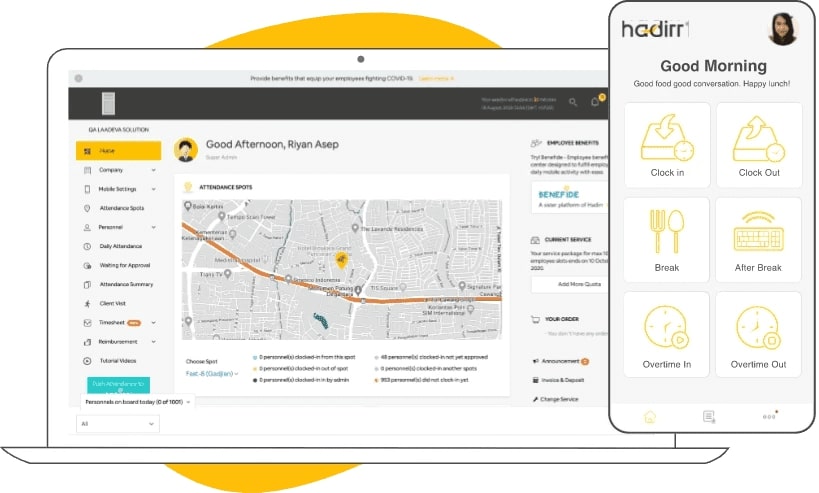
Hadirr attendance lets employees clock in only at company-approved locations. Managers can see detailed location data in real time on the admin dashboard, giving instant visibility into who is where.
Adding facial recognition to GPS verification significantly reduces attendance fraud, particularly for staff working remotely or across multiple sites. This approach also supports mobile workforce management, allowing employees to clock in without shared hardware or fingerprint devices.
Client Visit App: Structured, Location-Based Visit Logs
Hadirr’s client visit app allows field and sales teams to:
- Record actual location
- Save digital signatures
- Document meeting length and content
Data flows in real time to dashboards, enabling quick decisions to improve sales or field performance. Standardised time-tracking reports reduce manual work for HR and team leaders.
For Malaysian businesses concerned about client-site fraud, this acts as a comprehensive client site visit tracking solution:
- Each visit log ties directly to the employee’s GPS location
- Digital signatures and meeting details provide context and proof
- Standardised reports make it easy to see who visited which client, when, and for how long
Combined with geofenced attendance, this provides end-to-end visibility from clock-in to client visit to clock-out—all verified with GPS and facial recognition.
Using Hadirr as an “Anti-Fake GPS” Layer
While Hadirr doesn’t explicitly market as “anti-fake GPS,” the combination of geofencing, facial recognition, and GPS-tied client visit logs effectively prevents location spoofing:
- Geofencing attendance system – Clock-ins restricted to approved locations prevent employees from checking in anywhere their phone reports GPS.
- Face-verified presence – Facial recognition ensures the person clocking in is the actual employee, addressing buddy punching and some device-sharing fraud.
- GPS-tied client visit records – Real-time location and meeting data make it far harder to claim visits that never happened or to “recreate” routes later.
For Malaysian business leaders—owners, HR managers, operations heads—this means greater confidence that reports reflect reality on the ground without needing to become GPS security experts.
Also read: Top 70 FMCG Companies in Indonesia 2025
Why Malaysian Businesses Should Consider Hadirr for Geofencing Client Sites

If client-site fraud, off-site clock-ins, or unverifiable visit reports have created payroll disputes or operational blind spots in your organisation, your current tools may not be giving you the control and visibility required to manage mobile teams effectively.
Hadirr combines geofenced attendance, face-validated verification, and structured client site visit tracking in one integrated platform. Employees can clock in only at approved locations, while field and sales teams log visits with GPS validation, digital signatures, and time-stamped records that create defensible audit trails.
For business owners, HR managers, and operations leaders in Malaysia and Singapore, this means:
- Clearer audit trails for payroll, allowances, and incentives
- Stronger proof that client visits and field work actually occurred
- Reduced exposure to employee location fraud and fake GPS claims
- Less time spent reconciling inconsistent attendance and visit reports
If strengthening geofencing client controls and eliminating client-site fraud is a priority, Hadirr provides a practical and scalable solution. Start your free trial today and secure accurate, verifiable records across every client location.