

How to Track Field Sales in Malaysia Without Violating PDPA
Your field sales reps are the company’s revenue engine. They prospect, pitch, negotiate, maintain relationships, and close deals across territories that managers rarely see firsthand. When performance is strong, that mobility is an asset. When numbers start slipping, it becomes a blind spot.
Without structured visibility into where reps go, which clients they visit, and how their time is spent, management decisions rely on assumptions. Mileage claims may not align with territories. CRM entries may not match reported visits. Coaching conversations become debates rather than diagnostics.
The instinctive solution is simple: install GPS tracking, introduce monitoring apps, and tighten oversight.
In Malaysia, employee GPS tracking for field sales teams is no longer just an operational upgrade—it is a legal decision. As companies strengthen field sales tracking systems to improve accountability, they must also ensure PDPA compliance to avoid regulatory risk.
Over the past two years, Malaysia’s data protection framework has tightened significantly. Amendments to the Personal Data Protection Act (PDPA) 2010 have reclassified biometric data as sensitive personal data, introduced mandatory Data Protection Officers for certain organisations, and strengthened enforcement mechanisms. GPS coordinates, timestamps, facial scans, device identifiers, and location logs all fall within the definition of personal data.
If implemented carelessly, employee tracking can expose companies to penalties of up to MYR 300,000 and two years’ imprisonment per offence.
The challenge, then, is not whether to track. It is how to track responsibly—improving accountability and revenue visibility without increasing legal exposure.
This article explains how Malaysian businesses can monitor field sales teams effectively while remaining aligned with PDPA requirements and employment law principles.
The Business Case for Tracking Field Sales Reps

Across Malaysia, SMEs deploy mobile sales staff in FMCG distribution, pharmaceutical detailing, property sales, insurance, and B2B services. Despite different industries, managers report the same operational blind spots:
- Reps claim 10 client visits. The CRM shows five.
- Mileage claims don’t match territories.
- Revenue targets slip without clear diagnostic data.
- Coaching conversations rely on anecdotal explanations.
Without structured tracking, accountability depends heavily on manual reporting. That creates gaps—intentional or not.
This is where modern sales team monitoring tools change the equation.
Instead of relying on end-of-day summaries, businesses gain:
- Automatic visit logs with timestamps and GPS validation
- Route visibility to reduce wasted travel time
- Real-time dashboards that flag stalled pipelines
- Verified records that support SLA compliance and incentive payouts
The impact is practical and measurable. Route optimisation reduces unnecessary mileage costs. Verified visit data strengthens client reporting. Managers can coach using activity insights instead of assumptions. Performance conversations become data-driven, not emotional.
For growing businesses, that operational clarity directly supports revenue growth.
However, there is an important reality to acknowledge.
Tracking tools do not just collect performance data—they collect personal data. GPS coordinates, device identifiers, photos, timestamps, and in some cases biometric verification all fall within the scope of Malaysia’s PDPA.
The moment you activate a tracking feature, compliance obligations begin.
That does not mean you should avoid tracking. It means you must implement it correctly—balancing accountability, transparency, and legal safeguards.
Malaysia’s Legal Framework: What Employers Must Understand Before Tracking Field Sales

Employee tracking is no longer just an HR policy issue—it is a regulatory compliance matter with potential criminal liability. Before deploying GPS-based monitoring for sales teams, Malaysian employers must understand how multiple laws intersect.
The PDPA and Its Seven Principles
The Personal Data Protection Act 2010 (PDPA) governs the commercial processing of personal data in Malaysia. When you track field representatives, every PDPA principle applies.
The Act is built on seven core principles:
- General Principle – Personal data may only be processed for a lawful purpose directly related to the employer’s business activity, and only with the data subject’s consent.
- Notice and Choice Principle – Employers must provide written notice (in both Malay and English) clearly explaining what data is collected, why it is collected, how it will be used, and what rights employees have.
- Disclosure Principle – Access to collected data must be limited to authorised parties only.
- Security Principle – Employers must implement practical safeguards to prevent loss, misuse, or unauthorised access.
- Retention Principle – Personal data cannot be kept longer than necessary.
- Data Integrity Principle – Data must be accurate, complete, and up to date.
- Access Principle – Employees have the right to access and correct their personal data.
When applied to sales monitoring, this means GPS logs, timestamps, images, and verification records must all be collected with transparency and proper safeguards.
Non-compliance is not a minor administrative issue. Violations carry significant financial penalties and potential imprisonment.
For business owners, that shifts tracking from a “productivity tool” discussion into a risk management decision.
2024 Amendments: Biometric Data and Bigger Penalties
The PDPA Amendment Act 2024, implemented in stages from January through June 2025, introduced changes that directly impact employee GPS tracking Malaysia.
Three updates are especially critical:
1. Biometric Data Is Now Sensitive Personal Data
Biometric data—including facial recognition scans, fingerprints, and voice identification—is now explicitly classified as sensitive personal data. Any tracking app that captures employee selfies or uses facial verification requires explicit, documented consent before processing.
2. Mandatory Data Protection Officers (DPOs)
Organisations handling significant volumes of personal data must appoint a Data Protection Officer who is a Malaysian resident, fluent in Malay and English, and trained in PDPA compliance.
3. Mandatory Data Breach Notification
Data breach notification is now compulsory. Organisations must notify the Commissioner within 72 hours of a notifiable breach and inform affected individuals within seven days if significant harm may occur.
For companies managing mobile teams, this means any system that records GPS trails, location history, selfies, or biometric validation must meet higher consent, documentation, and security standards.
Choosing the wrong tracking system is no longer just inefficient—it can expose the business to regulatory investigation.
Employment Act 1955: The Labour Side
While the Employment Act 1955 does not specifically regulate GPS tracking, it defines the employment relationship and reinforces the expectation that employers act reasonably.
Legal commentators in Malaysia generally agree that workforce location data collected during working hours can fall within an employer’s legitimate interest—provided the scope, purpose, and handling are proportionate and clearly disclosed.
The problem arises when monitoring exceeds reasonable boundaries. Tracking employees during annual leave, medical leave, or outside working hours crosses into legally risky territory.
A widely discussed 2025 incident involving a Malaysian employer who demanded live GPS data from an employee on annual leave sparked significant public backlash and legal scrutiny. Employment law experts indicated that such monitoring likely contravenes PDPA principles and exceeds reasonable employer authority.
Common PDPA Compliance Mistakes in Field Sales Monitoring

Many businesses implement field sales tracking tools without legal groundwork. The most common compliance gaps include:
No written notice or valid consent—Employers deploy an app and assume that download equals consent. Under the PDPA, organisations must issue a formal written notice explaining what data is collected, the purpose of processing, who can access it, and how long it will be retained. Consent must be explicit—especially when biometric data such as facial recognition is involved.
Tracking outside working hours—Applications that run 24/7 capture location data when reps are off duty. This is likely excessive under the General Principle, which requires personal data collection to be limited and proportionate to its purpose.
No defined data retention limits—Retaining years of GPS logs without a deletion policy breaches the Retention Principle. Organisations must define how long location data is necessary and enforce structured deletion schedules.
Ignoring employee access rights—Under the Access Principle, employees are entitled to request access to their personal data. Failing to respond within a reasonable timeframe constitutes non-compliance.
Overlooking the DPO requirement—If your organisation processes location and biometric data at scale, the amended PDPA may require the appointment of a Data Protection Officer. Operating without proper oversight creates a structural compliance risk.
A Compliant Framework for Field Sales Tracking

Tracking field sales activity can be legitimate and commercially necessary. The key is proportionality, transparency, and documentation.
Malaysian employers should implement several core safeguards:
1. Define a legitimate purpose
Your tracking objective must be directly related to business operations. Verifying client visits for SLA compliance, improving route efficiency, preventing time fraud, or strengthening field rep accountability are defensible purposes. “Monitoring staff” is not specific enough.
2. Issue written notice before deployment.
Provide a bilingual privacy notice explaining what data is collected—GPS coordinates, timestamps, photos, facial scans—why it is collected, who can access it, and how long it will be retained. Employees should receive this before the app goes live, not after.
3. Obtain the right level of consent.
Standard location tracking during working hours requires documented consent. Biometric features require explicit consent under the amended PDPA. Keep proper records.
4. Limit tracking to working hours.
Monitoring should be restricted to active duty periods. Systems should allow tracking to pause automatically outside assigned shifts. Excessive monitoring is one of the fastest ways to create legal risk.
5. Secure and control access.
Location histories and client visit tracking records contain sensitive operational information. Encrypt the data, restrict dashboard access to authorised personnel, and log internal access activity.
6. Set clear retention rules.
For most commercial purposes, retaining verified visit data for 12–24 months is generally proportionate. Beyond that, justification becomes harder. Automate deletion rather than relying on manual cleanup.
7. Assess whether a DPO is required.
If your organisation processes personal data at scale, review whether the DPO mandate applies. Ignoring this assessment can expose the company during regulatory scrutiny.
When these controls are in place, tracking becomes a governance tool—not a liability.
Why Compliance Strengthens Sales Performance

There is a common misconception that heavier surveillance produces better results. In practice, excessive monitoring often erodes morale and lowers adoption.
A legally structured system builds trust. When field sales reps understand what is collected and why, usage consistency improves. Better adoption produces cleaner data. Cleaner data strengthens forecasting accuracy, territory planning, and coaching precision.
Compliance also protects employer brands. In Malaysia’s competitive labour market, professional sales talent gravitates toward organisations perceived as fair and modern—not invasive.
Done properly, compliance becomes a commercial advantage.
Technology Features That Make Compliance Easier

Not all monitoring platforms prioritise PDPA compliance for employers. Some design their systems around constant surveillance. Others intentionally structure data collection around necessity and proportionality.
A compliance-aligned field sales tracking system includes several core safeguards:
- Geofencing Attendance Instead of Continuous Tracking
The system captures location data only when employees enter or exit approved client zones, supporting data minimisation and avoiding unnecessary movement monitoring. - Time-Bound Activation
The platform restricts tracking to working hours, reducing the risk of excessive or disproportionate data collection. - Consent-Aware Biometric Workflows
The system structures facial recognition and other biometric processes to support proper documentation and explicit consent requirements under Malaysia’s PDPA. - GPS Integrity Controls
Built-in anti-fake GPS detection prevents manipulation without relying on intrusive 24/7 surveillance. - Role-Based Access and Structured Reporting
The platform limits internal access to location and visit data, while generating structured, audit-ready reports instead of exposing raw GPS trails.
Technology does not replace policy—but well-designed systems actively reduce compliance friction. Hadirr embeds these safeguards directly into its platform to support mobile teams across Malaysia.
How Hadirr Supports PDPA-Compliant Field Sales Tracking in Malaysia

Tracking should reinforce accountability without creating legal uncertainty. That balance starts with system design.
Hadirr is built for mobile teams in Malaysia and Singapore, structuring employee GPS tracking Malaysia around verification, purpose limitation, and defensible reporting—not continuous surveillance.
GPS-Validated Client Visit Tracking
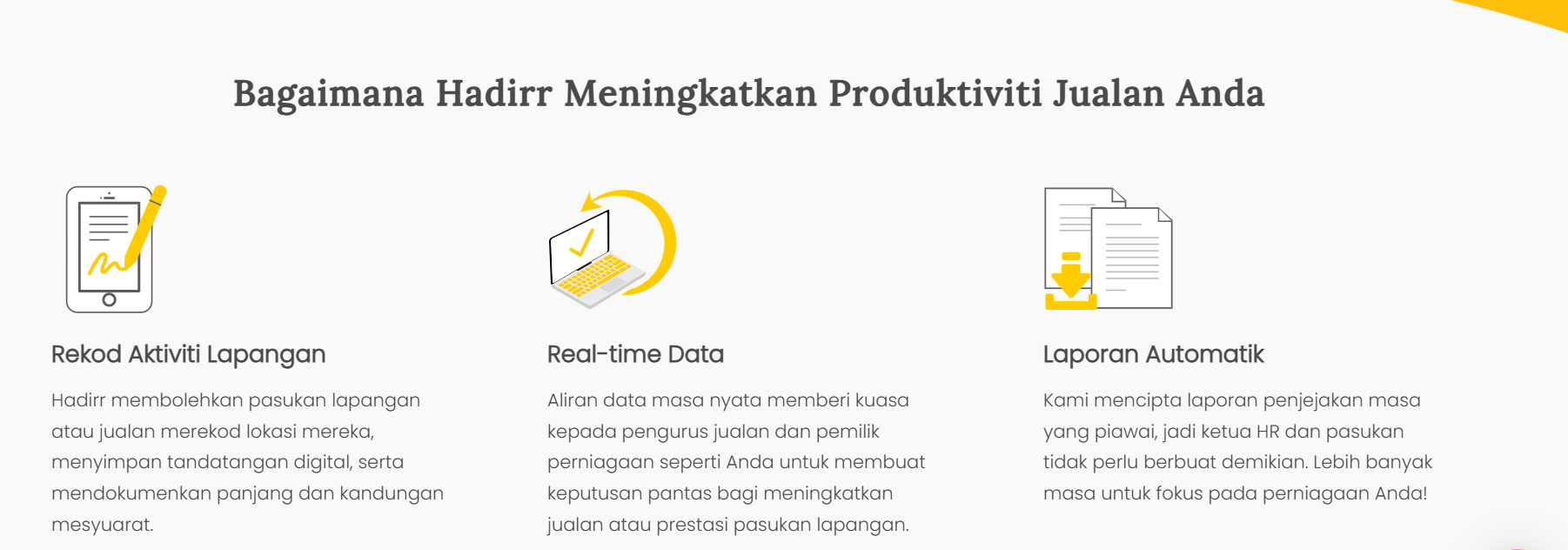
The platform records verified visit logs with GPS validation, timestamps, digital signatures, and structured meeting notes. Managers gain real-time visibility into field activity without requiring background 24/7 tracking.
Only operationally necessary data—location, time, and visit proof—is captured, with audit-ready reporting built in.
Geofencing Attendance with Controlled Biometric Verification
Geofenced attendance restricts clock-ins to approved locations instead of tracking unrestricted movement. Facial recognition verification confirms identity at the point of attendance, helping reduce impersonation and time fraud.
Because biometric data is classified as sensitive personal data under Malaysia’s amended PDPA, workflows are structured to support proper consent and controlled processing.
Integrated Mobile CRM for Field Sales Teams
Hadirr Sales also functions as a mobile CRM Malaysia teams can use to manage pipelines, log activities, and centralise customer data. Each verified visit links directly to a customer record and pipeline stage, turning tracking data into revenue visibility.
For organisations strengthening field rep accountability while maintaining PDPA compliance for employers, Hadirr provides a structured alternative to surveillance-heavy systems.
If you’re reviewing compliant field sales tracking solutions, choose a system designed for proportional data capture and audit defensibility.
Start your free trial and implement field sales tracking that strengthens accountability without increasing PDPA risk.