
Best Remote Sales Monitoring and CRM Tools in Singapore
Singapore’s fast-moving, service-driven economy increasingly relies on remote and hybrid sales teams. As a result, sales team productivity is no longer just an operational metric—it has become a board-level concern tied directly to revenue predictability and long-term sales performance management.
When managers lack visibility into client visits, stalled deals, or daily activity levels, forecasting turns into guesswork. The right remote sales monitoring tools address this by strengthening remote sales productivity and making calls, meetings, visits, and pipeline movement visible in real time.
This guide outlines the leading tools Singapore companies use to monitor distributed sales teams—and clarifies where Hadirr fits, particularly for mobile and field-based environments.
Remote Sales in Singapore: High Potential, Real Productivity Friction

SMEs form the backbone of Singapore’s economy and have accelerated their shift toward digitalisation and flexible work models.
Across Singapore and the wider region, this transition was driven by cost efficiency and broader access to talent—but it also introduced new operational complexity. Communication gaps widened, IT support became uneven, and maintaining accountability across distributed teams grew more challenging.
During Singapore’s Circuit Breaker period, many SMEs became familiar with remote-work platforms. Yet follow-up surveys suggested that executing core responsibilities, supervising field activity, and coaching employees remotely remained difficult in practice.
Across the Asia Pacific (APAC), flexible working arrangements are now the norm. Recent surveys show that around 84% of organisations have adopted hybrid (58%) or fully remote (26%) models, with 87% of business leaders prioritising productivity when selecting these arrangements. Singapore, widely regarded as one of APAC’s most digitally mature economies, has moved quickly in this direction.
For sales organisations, this structural shift has deeper implications. Revenue teams depend on consistent execution, disciplined follow-ups, and accurate pipeline visibility. When meetings move online or field activity becomes loosely structured, managers often lose real-time oversight of day-to-day execution.
This visibility gap is why more companies are investing in sales activity monitoring, sales performance management, and integrated remote sales team tools that log execution in real time and support measurable gains in sales team productivity.
Also read: Top Sales Management Software for Indonesian Businesses
What You Need to Track to Improve Sales Team Productivity

Before selecting any platform, define what “productivity” means for your distributed sales team. Without that clarity, even the best CRM will generate data without insight.
For most remote teams, productivity typically covers four dimensions:
- Activity volume: calls made, emails sent, meetings booked, client visits completed
- Pipeline flow: new deals created, stage movement, win/loss rates
- Time and coverage: territory coverage, account visit frequency
- Outcomes: revenue, average deal size, sales cycle length
Together, these indicators form the foundation of effective sales pipeline management and measurable sales team productivity.
Modern sales activity tracking software captures these metrics automatically, removing reliance on end-of-week spreadsheets. Many CRM platforms now provide real-time dashboards for activity tracking and pipeline health, allowing managers to intervene before deals stall.
For field-heavy teams, field sales tracking software and field sales productivity tools go further by adding geo-tracking, visit logs, and route optimisation. This ensures visibility not only into what is being sold, but where and how efficiently sales efforts are executed. These capabilities are increasingly associated with modern field force management systems.
In Singapore’s compact yet high-traffic landscape, tools that combine sales pipeline visibility with map-based interfaces and GPS tracking for sales reps are especially valuable. They reduce wasted travel time, prioritise high-value accounts, and replace anecdotal updates with verifiable data.
Also read: Tapping into Indonesia’s Special Economic Zones Advantage
Key Criteria for Remote Sales Monitoring Tools

Research across sales technology and field-sales operations points to several must-have capabilities for improving sales team productivity in remote or hybrid setups.
Mobile-first experience and mobile sales CRM
A strong CRM for sales teams should support seamless mobile updates without slowing down field execution. Reps should be able to update deals, log notes, and record visits directly from their smartphones—even in areas with unstable connectivity.
Geo-tracking and check-ins
A strong CRM for remote sales includes real-time geo-tracking, location check-ins, and route visualisation. These features help managers validate field visits and optimise territory planning.
Automated reporting and alerts
Advanced sales reporting software reduces administrative friction and supports faster executive-level decisions. Dashboards and automated reports reduce administrative burden and enable faster decisions when activity drops or specific pipeline stages consistently slow down.
Centralised customer data
A single, accessible database prevents information silos and missed opportunities—a core promise of most CRM systems used in Singapore.
Scalability and integrations
Tools should integrate seamlessly with email, calendars, and often accounting or ERP systems to avoid duplicate data entry and maintain clean workflows.
The tools below meet many of these criteria, with strengths varying depending on whether your team operates in inside sales, fully remote roles, or primarily in the field.
Also read: A Foreign Business Guide to Indonesia’s Product Certification
Overview: Top Tools to Monitor Remote Sales Team Productivity
The table below summarises six widely used platforms that Singapore companies rely on to monitor remote and field sales reps. It includes global CRM leaders, sales-focused systems, and a regional solution designed specifically for mobile and field workflows.
| Tool | Best For | How It Helps Productivity | Why It Matters for Singapore |
| Salesforce Sales Cloud | Larger SMEs and enterprises | Enterprise-grade CRM software with advanced automation, forecasting, and centralised sales pipeline reporting. | Suitable for complex B2B environments in Singapore requiring structured controls, compliance, and regional visibility. |
| HubSpot Sales Hub | Startups and marketing-driven SMEs | Combines email tracking, meeting scheduling, deal management, and sales automation in one CRM platform. | Strong fit for digital-first Singapore teams running inbound and content-led remote sales strategies. |
| Pipedrive | SMBs seeking simple sales pipeline visibility | Visual sales pipeline dashboards, activity targets, and lightweight CRM workflows with fast setup. | Practical CRM software option for smaller Singapore teams transitioning from spreadsheets to structured systems. |
| SPOTIO | Outside and field sales teams | Territory planning, route optimisation, and real-time rep tracking to improve field sales productivity. | Relevant for Singapore companies managing road-based sales reps where geographic coverage impacts revenue. |
| HashMicro CRM | SMEs and enterprises seeking CRM + ERP integration | Integrates CRM software with finance, inventory, and operations for unified pipeline and operational oversight. | Useful for Singapore organisations needing cross-department visibility within structured enterprise workflows. |
| Hadirr | Remote and field teams needing GPS + CRM | Combines GPS visit tracking, automated reporting, and mobile CRM software for structured pipeline and customer management. | Designed for Southeast Asian mobile workforces, aligning with Singapore’s field-heavy SME and distribution sectors. |
Also read: A Foreign Business Guide to Indonesia’s Product Certification
Detailed Comparison of Remote Sales Monitoring Tools

While the table provides a snapshot, understanding the positioning of each tool helps clarify which type of organisation it best serves.
Salesforce Sales Cloud
Salesforce Sales Cloud is often chosen by larger SMEs and enterprises with complex B2B sales cycles. It offers deep CRM functionality, workflow automation, and advanced reporting.
For organisations operating across Singapore and the wider region, Salesforce provides structured governance over opportunity stages, forecasting, and performance metrics. However, implementation can require consulting resources and longer setup timelines.
It is best suited to teams prioritising enterprise-level sales pipeline control and advanced analytics.
HubSpot Sales Hub
HubSpot Sales Hub is popular among startups and marketing-driven SMEs. It integrates email tracking, meeting scheduling, sequences, and deal management within one interface.
For inbound-led teams, this alignment between marketing automation and CRM simplifies remote selling workflows. HubSpot is particularly effective for Singapore companies running content-driven or digital acquisition strategies across APAC.
It balances usability with structured CRM functionality.
Pipedrive
Pipedrive focuses on simplicity and visual clarity. Designed for SMBs, it provides intuitive sales pipeline views, activity goals, and dashboard reporting with minimal configuration.
For smaller Singapore teams transitioning from spreadsheets to structured CRM software, Pipedrive offers fast adoption and low implementation complexity.
It is well suited to organisations that value ease of use over advanced customisation.
SPOTIO
SPOTIO is designed specifically for outside and field sales teams. It emphasises territory management, route optimisation, and real-time rep tracking.
For businesses where physical coverage and visit efficiency directly influence revenue, SPOTIO strengthens oversight of field execution. This makes it relevant for industries such as FMCG distribution, industrial supplies, or on-site services within Singapore.
Its functionality is narrower than traditional CRM platforms, but significantly deeper in field-specific capabilities. This makes it particularly relevant for organisations prioritising mobile sales tracking and stronger on-the-ground accountability.
HashMicro CRM
HashMicro offers CRM functionality as part of its broader ERP ecosystem.
For Singapore companies seeking integrated finance, inventory, and CRM systems, HashMicro provides cross-department visibility. While not as field-specific as SPOTIO, it supports structured sales pipeline tracking within larger enterprise workflows.
The software targets organisations needing CRM-ERP integration within a unified system.
Hadirr
Hadirr combines GPS-based visit monitoring with mobile CRM functionality in an ecosystem designed for Southeast Asian mobile workforces, including Singapore.
The platform integrates:
- Hadirr Monitoring Sales for field activity verification
- Hadirr Sales as a mobile CRM for pipeline and customer management
This structure connects rep location, client visits, and deal progression within one workflow, reducing reporting gaps between field execution and pipeline oversight. By unifying monitoring and CRM workflows, the platform helps organisations improve sales efficiency without increasing administrative burden.
Sales Monitoring
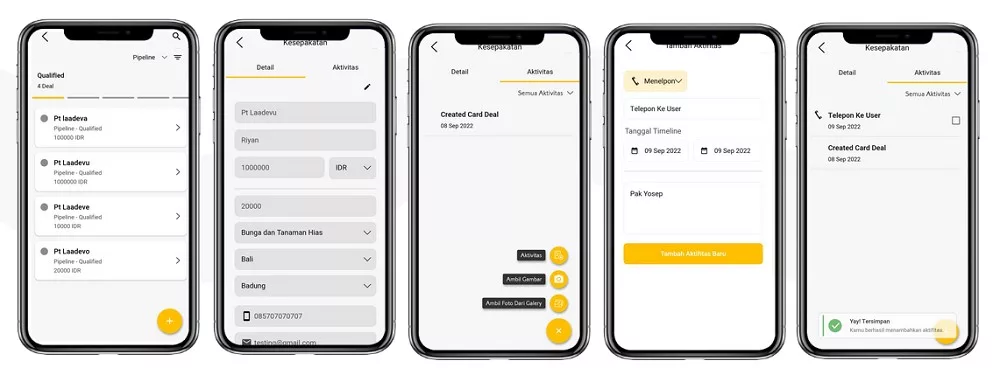
The Monitoring Sales module captures field activity through GPS logs, digital signatures, and uploaded meeting documents during client visits. Visit data is automatically stored in the admin portal, where managers can generate structured reports without manual consolidation.
For Singapore teams covering industrial estates, commercial districts, or regional routes, this provides verified coverage data and clearer accountability—a key requirement for modern sales activity tracking software.
Mobile CRM
Hadirr Sales functions as a mobile-first CRM that structures pipeline stages, customer records, and rep activities in one system. Reps can update deals and log visits directly from the field, while managers monitor targets and activity without relying on spreadsheets.
By combining mobility with structured reporting, the platform supports more disciplined execution across distributed sales teams.
Also read: Why Foreign Companies in Indonesia Struggle to Hire Top Locals
How to Choose the Right Tool for Your Remote Sales Team

When evaluating these platforms for Singapore, focus on practical considerations rather than feature lists alone.
1. Is your team primarily inside sales or field-based?
Inside-sales teams working mainly through calls and video typically prioritise automation, email tracking, and structured pipelines. In such cases, platforms like Salesforce, HubSpot, or Pipedrive may align well.
Field-oriented teams, however, benefit more from solutions that emphasise territory coverage, route optimisation, and verified visit tracking—such as SPOTIO or Hadirr.
2. How critical is geo-tracking and visit verification?
If confirming client visits and improving route efficiency are business priorities, tools with strong geo-tracking and map-based visibility should be central to your field sales productivity tools stack. Without location-level data, managers often rely on assumptions rather than evidence.
3. Do you already use HR or attendance systems?
Some organisations prefer to consolidate attendance tracking and sales activity monitoring within a single ecosystem. In such cases, combining attendance features with Monitoring Sales and CRM functionality can simplify oversight and reduce fragmented reporting.
4. What are your budget and implementation constraints?
Enterprise-grade CRMs may offer extensive functionality but often require longer rollout timelines and external support. Lighter or region-focused solutions can typically be deployed faster—an important factor if your goal is near-term improvement in sales team productivity.
Also read: 9 Current Trends in Indonesia’s Food & Beverage Industry
From Field Activity to Measurable Sales Team Productivity

For founders and business leaders in Singapore, improving sales team productivity is ultimately about protecting margins, strengthening execution discipline, and ensuring consistent revenue growth.
When sales activity happens outside the office—across industrial estates, commercial districts, or regional routes—visibility becomes limited. Without structured monitoring, leadership relies on summaries, assumptions, and end-of-month reports.
That creates risk:
- Missed follow-ups
- Inconsistent territory coverage
- Inflated activity reporting
- Pipeline stages that look healthy but lack real execution
Global CRM platforms such as Salesforce, HubSpot, and Pipedrive provide structured pipeline reporting. Field-focused tools like SPOTIO optimise routes. ERP systems like HashMicro align sales with finance and operations.
However, when location tracking, visit verification, and CRM updates sit in separate systems, business owners still lack one clear picture of execution.
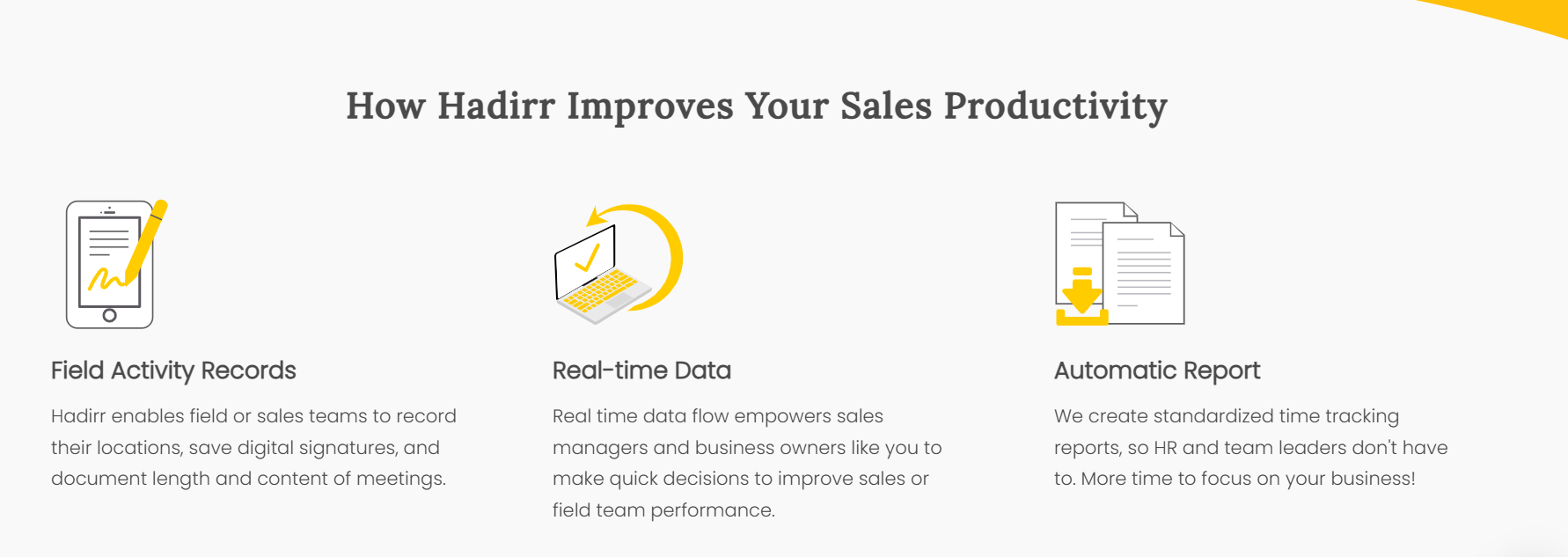
Hadirr addresses this gap by combining:
- GPS-based visit monitoring
- Digital proof of client meetings
- Automated visit reports
- Mobile CRM pipeline tracking
- Attendance tracking
In one connected workflow.
For business owners and HR leaders managing distributed teams, this means:
- Clear visibility into where sales teams operate
- Structured documentation of client engagement
- Reduced manual reporting
- Stronger accountability without micromanagement
- Better forecasting supported by verified field activity
In short: more control, less uncertainty.
If your organisation is reviewing how to improve sales team productivity in a remote or hybrid environment, the next step is not necessarily adding more tools—but ensuring monitoring, CRM, and execution workflows operate within one connected system.
When monitoring, CRM, and sales reporting software work together in a unified platform, leadership gains clearer oversight, stronger accountability, and greater control over revenue performance—without increasing administrative complexity.
Learn how Hadirr supports structured, accountable field sales management in Singapore.